

Solution
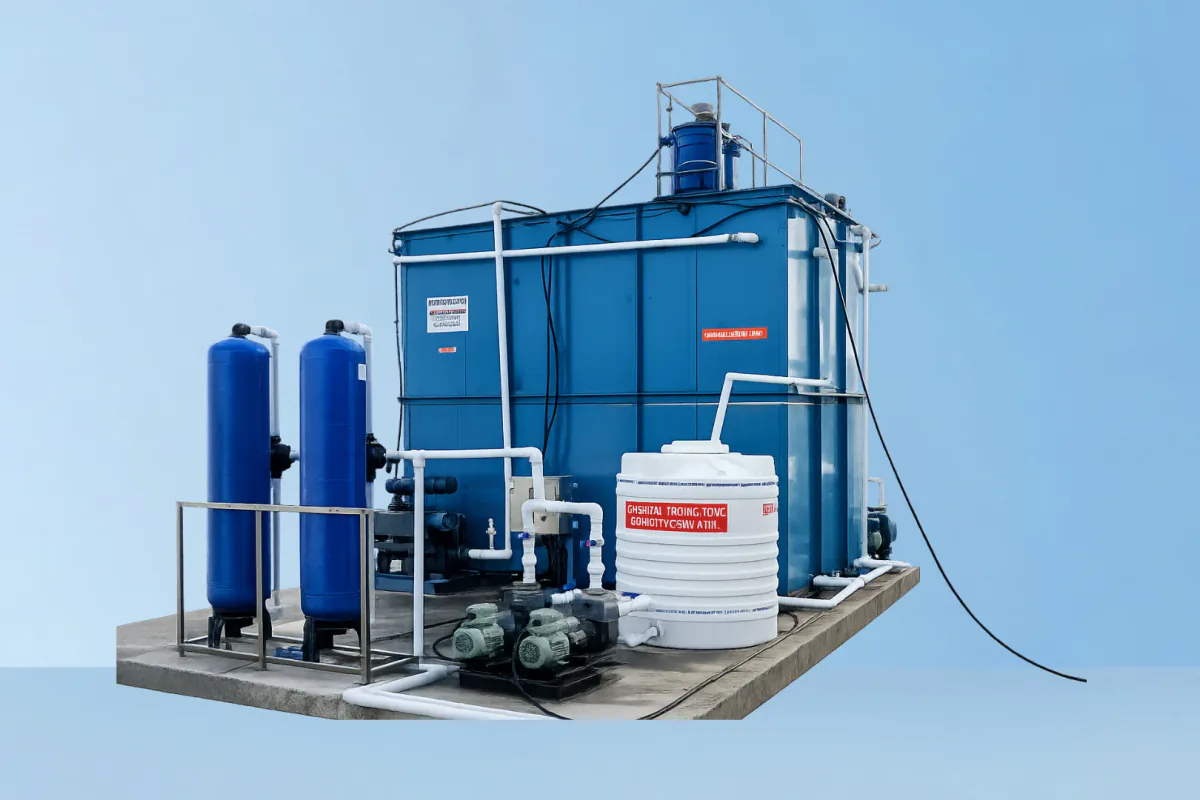
STP Plant Manufacturer in Bhiwadi
Sewage treatment plants for housing societies, hotels and schools, sized in KLD to your sewage load and built on MBBR or SBR.
How a project runs
- 01
Load assessment
Number of people or the daily sewage flow in KLD, peak hours, and what the treated water will be used for — discharge, gardening or flushing.
- 02
Process design
Treatment scheme (MBBR, extended aeration or SBR), tank sizes and equipment list, issued as a flow diagram before anything is ordered.
- 03
Fabrication and civil work
Equipment fabricated and supplied; RCC tanks built in your scope to the sizes fixed in the design, or a packaged unit where space is tight.
- 04
Seeding and commissioning
Hydro test, bioculture seeding, and start-up on live sewage. The outlet is tested against your consent parameters before handover.
- 05
Operation and chemicals
Bioculture, polyelectrolyte and chlorine on a monthly cycle, with O&M or an AMC if you would rather not run the plant in-house.
Typically installed for
- Housing societies and townships
- Hotels and resorts
- Schools and institutions
- Hospitals
- Commercial complexes
- Factory colonies
Bhiwadi · Alwar, Rajasthan
We are an STP plant manufacturer in Bhiwadi, building sewage treatment plants for housing societies, hotels, schools and institutions across the Bhiwadi–Neemrana–Dharuhera belt, as well as factory colonies in the RIICO industrial area. Each plant is sized to the actual sewage load in KLD and designed to meet Rajasthan or Haryana Pollution Control Board discharge norms, with the treated water fit for gardening or flushing reuse where the consent allows.
Need an effluent plant for a factory? See ETP plant setup
STP technologies we build
- MBBR (moving bed biofilm reactor) — compact, handles load swings, the usual choice for societies and hotels
- Extended aeration / activated sludge — simple to run where space is available
- SBR (sequencing batch reactor) — batch treatment with a small footprint
- Packaged STPs for small loads and sites without space for civil tanks
Main parts of an STP
- Bar screen and oil and grease trap
- Equalisation tank to even out peak flows
- Aeration tank with blowers and diffusers (or MBBR media)
- Tube settler or clarifier
- Pressure sand filter and activated carbon filter
- Chlorination before reuse or discharge
- Sludge holding tank and filter press or sludge drying beds
Typical STP capacities
Plants are sized in kilolitres per day (KLD). As a guide, a housing society produces roughly 100–135 litres of sewage per resident per day, and a factory roughly 30–45 litres per worker per shift. Common sizes run from 10 KLD for a small unit to several hundred KLD for a township.
Send your headcount or measured flow and we will size the plant and give a budgetary quote.
What we need from your side
Space for the tanks (or a packaged unit), 3-phase power near the plant, water for testing, site access, and an operator or an O&M contract.
Support after the plant is running
Monthly bioculture, polyelectrolyte and chlorine supply, outlet testing, blower and pump spares, and AMC cover.
Areas we serve
We install and service across Bhiwadi and the wider industrial belt, including the RIICO zones across Alwar district:
- Bhiwadi
- Chopanki
- Khushkhera
- Tapukara
- Karoli
- Neemrana
- Bawal
- Dharuhera
- Gurugram (Gurgaon)
- Bilaspur
- Ghiloth
- Kharkhoda
- Manesar
FAQs
Common questions
Common questions about STP Plant Manufacturer. If yours is not here, send us an enquiry.
Are you an STP plant manufacturer in Bhiwadi?
Yes. Daksha Enterprises designs, fabricates, installs and commissions sewage treatment plants from Bhiwadi for factories, housing societies, hotels and institutions across the Bhiwadi, Neemrana and Dharuhera belt.
Which STP technology is best?
MBBR suits most societies and factories because it is compact and handles load swings. Extended aeration is simpler where space allows, and SBR suits small footprints. We recommend one after looking at your load and site.
How is STP capacity calculated?
STP capacity is the daily sewage flow in KLD. It is estimated from the number of residents or workers and their water use, plus a margin for peaks. Measured flow, where available, is better.
Can treated STP water be reused?
Yes, where your consent allows. Treated water with sand and carbon filtration and chlorination is commonly reused for gardening, flushing and cooling tower make-up.
Do you also build ETPs?
Yes. We build effluent treatment plants for process wastewater, and supply the ETP and STP chemicals both kinds of plant run on.
Do you offer STP operation and maintenance?
Yes. We supply bioculture, polyelectrolyte and chlorine monthly and offer O&M or AMC cover with outlet testing and spares.
Enquiries
Get a quote for STP Plant Manufacturer
Send us the site details and the load. We will come back with a configuration and a budgetary price.
 Send an enquiry