

Solution
ETP / STP Plant Setup
Effluent and sewage treatment plants built to meet discharge norms, with the dosing programme to keep them there.
How a project runs
- 01
Effluent characterisation
A sample off your line, tested for the parameters that drive the design — volume per day, operating hours, peak factor, and the organic and chemical load the plant has to carry.
- 02
Process design
The treatment scheme, tank sizes and equipment schedule set against that analysis, issued as a flow diagram and general arrangement drawings before anything is ordered.
- 03
Civil and mechanical build
The RCC tanks are built in your scope to the sizes fixed at detailed engineering. Equipment supply typically runs ten to twelve weeks from order, with erection starting a week or two after material reaches site.
- 04
Culture seeding and start-up
Hydro testing on fresh water, then the aeration tank is seeded and the plant is brought up on live effluent. The outlet is tested against your consent parameters before handover.
- 05
Monthly dosing supply
Lime, alum or PAC, polyelectrolyte, chlorine and nutrients on a monthly cycle, with O&M support or an AMC if you would rather not run the plant in-house.
Typically installed for
- Textile and dyeing
- Paint and coating units
- Auto components
- Food and beverage processing
- Pharmaceuticals and chemicals
- Electroplating and metal finishing
- Townships and commercial complexes
Bhiwadi · Alwar, Rajasthan
We build ETPs for process effluent and STPs for sewage, sized to your consent parameters, not a standard drawing.
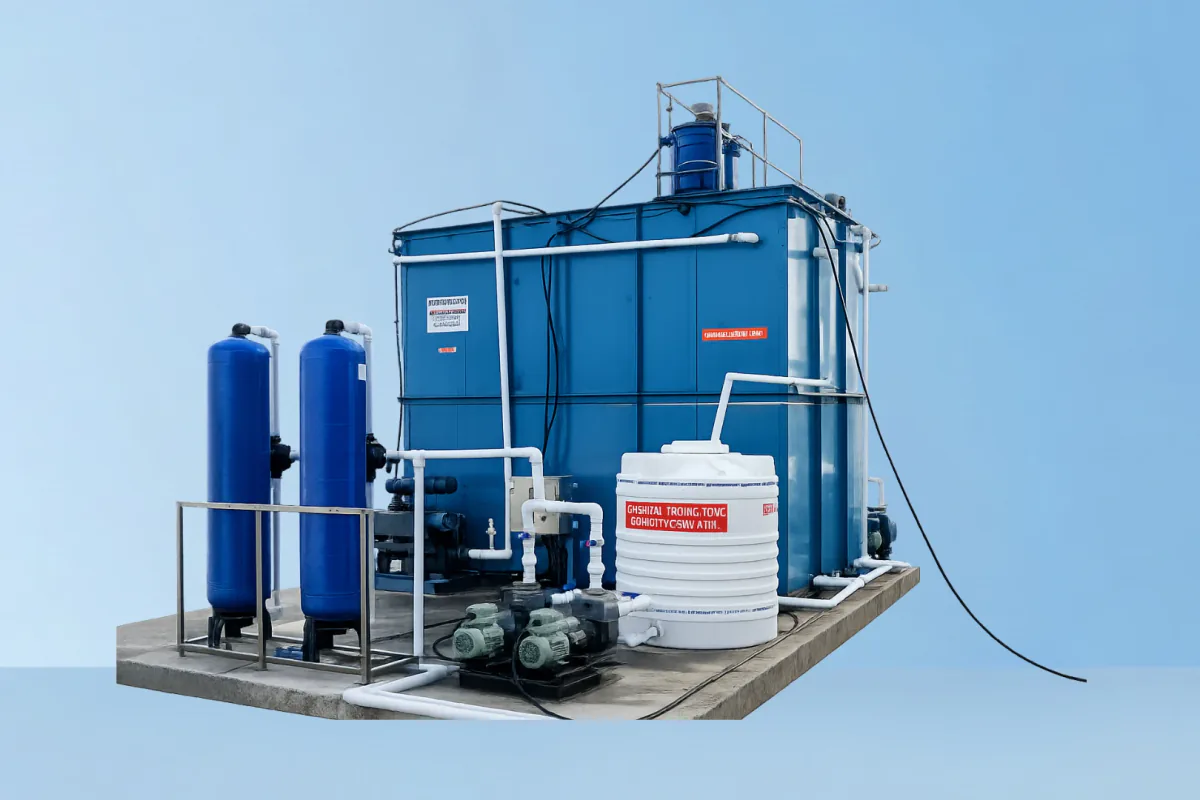
Main parts of the plant
- Screen and oil trap, to catch solids and floating oil first
- Dosing system, to settle out fine particles chemically
- Aeration tank with blowers, where the biological treatment happens
- Clarifier, to separate treated water from the settled biomass
- Sand and carbon filters, for a final polish
- Chlorine dosing, before the water leaves the plant
- Control panel, running the whole plant
- Sludge dewatering unit, to press out the leftover solids
What the treated water comes out at
A plant on this scheme is designed around outlet targets in the range of:
- pH between 6.5 and 8.5
- Total suspended solids under 50 mg/l
- BOD under 30 mg/l
- COD under 50 mg/l
- Oil and grease under 10 mg/l
The exact figures are fixed against your inlet analysis at the design stage, and are written into the offer. Outlet quality tracks inlet quality — a change in what enters the plant, or an adulterated batch, changes what the plant can hold at the other end.
What we need from your side
Civil tanks and foundations, power (3-phase 415 V near the plant), water for testing, site access and storage, and an operator.
Support after the plant is running
Monthly dosing chemicals, O&M or AMC support, outlet testing, and spares — set up at the time of order.
Areas we serve
We install and service across Bhiwadi and the wider industrial belt, including the RIICO zones across Alwar district:
- RIICO Industrial Area, Bhiwadi
- Chopanki
- Khushkhera
- Tapukara
- Karoli
- Neemrana
- Bawal
- Dharuhera
- Gurugram (Gurgaon)
- Bilaspur
- Ghiloth
- Kharkhoda
- Sonipat
- Manesar
FAQs
Common questions
Common questions about ETP / STP Plant Setup. If yours is not here, send us an enquiry.
What is the difference between an ETP and an STP?
An ETP treats industrial effluent generated during manufacturing — process water carrying chemical load, oil, pigment or colour. An STP treats domestic sewage from toilets, canteens and hand wash points in offices, townships and commercial buildings. Both run on a similar backbone, but an ETP needs a chemical treatment stage ahead of the biological one that an STP largely does not.
How is an ETP or STP designed for a specific factory?
The design starts from an effluent sample and the numbers around it: volume per day in KLD, daily operating hours, the peak factor the plant has to absorb, and the organic and chemical load in the water. Those fix the tank sizes and the equipment schedule, which are then set against the outlet parameters your consent requires — typically pH 6.5 to 8.5, TSS under 50 mg/l, BOD under 30 mg/l, COD under 50 mg/l and oil and grease under 10 mg/l.
What is in my scope and what is in yours for an ETP installation?
The RCC tanks, equipment foundations, a 3-phase 415 V supply terminated near the plant, one fill of fresh water for hydro testing, continuous effluent for commissioning, covered storage and an operator are in your scope. Everything electro-mechanical — screens, pumps, dosing systems, DAF, blowers, clarifier internals, filters, sludge dewatering, piping, instruments and the control panel — is designed, supplied, erected and commissioned by us.
How long does an ETP or STP project take from order to commissioning?
Equipment supply typically runs ten to twelve weeks from the order, erection begins a week or two after material reaches site, and commissioning follows once effluent and power are available. The civil tanks are built in parallel on your side, so a site that starts its RCC work early is usually the one that commissions first.
Do you supply dosing chemicals and maintenance after the plant is commissioned?
Yes. A biological plant needs feeding and watching, so we supply the monthly chemical programme — lime, alum or PAC, polyelectrolyte, chlorine and nutrients — along with outlet testing, media and spares, sludge handling support, and O&M or an Annual Maintenance Contract. Equipment carries a twelve-month warranty from supply.
Do you install ETP and STP plants in Bhiwadi and nearby industrial areas?
Yes. We provide ETP and STP plant setup services for industries across RIICO Industrial Area, Bhiwadi, Chopanki, Khushkhera, Tapukara, Karoli, Neemrana, Bawal, Dharuhera, Gurugram (Gurgaon), Bilaspur, Ghiloth, Kharkhoda, Sonipat and Manesar.
Enquiries
Get a quote for ETP / STP Plant Setup
Send us the site details and the load. We will come back with a configuration and a budgetary price.
 Send an enquiry